Mujina
高等学校 英語 第1学年 ReadingLiterature 目安 25 分
学習のめあて
- 小泉八雲が日本の怪談を英語でどう伝えたかを、原文で味わう
- 物語の三幕構成(出会い/恐怖/再出現)を英文の中で追い、語りのテンポの妙を読み取る
- 重要語彙(lonesome, crouching, implore, peddler, simultaneously など)を文脈の中で身につける
- 「日本の怪談」が英語圏で受け入れられた背景を考える
本文
Background (背景)
Lafcadio Hearn(ラフカディオ・ハーン、1850–1904)は、ギリシャ生まれ・アイルランドとイギリス育ちのジャーナリスト・作家。1890年に来日し、松江で小泉セツと結婚、日本に帰化して「小泉八雲(こいずみ・やくも)」となりました。彼は妻のセツが語り聞かせる日本の怪談を、独特の静謐で詩的な英語に書き直し、欧米に紹介しました。代表作『Kwaidan: Stories and Studies of Strange Things』(1904年、死の年に刊行)に収められた「Mujina」は、その中でも最も短く、最も鮮やかな一編です。
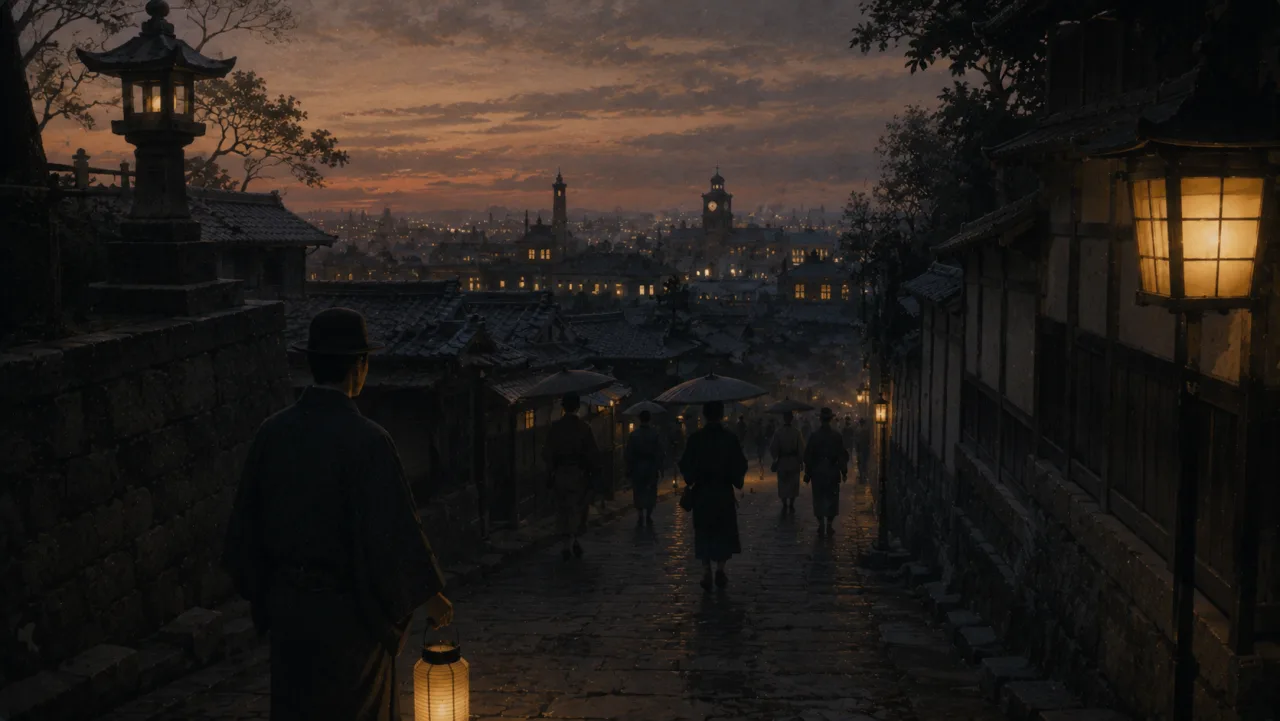
舞台は江戸・紀伊国坂(きいのくにざか)。今の東京都港区赤坂見附あたりの坂で、片側には弁慶堀、反対側には紀州徳川家上屋敷の長く高い塀が続いていました。明治の街灯と人力車が普及する前、夜になると人気がなく、「むじな」が出ると伝わっていたのです。
Original Text
On the Akasaka Road, in Tōkyō, there is a slope called Kii-no-kuni-zaka,—which means the Slope of the Province of Kii. I do not know why it is called the Slope of the Province of Kii. On one side of this slope you see an ancient moat, deep and very wide, with high green banks rising up to some place of gardens;—and on the other side of the road extend the long and lofty walls of an imperial palace. Before the era of street-lamps and jinrikishas, this neighborhood was very lonesome after dark; and belated pedestrians would go miles out of their way rather than mount the Kii-no-kuni-zaka, alone, after sunset.
All because of a Mujina that used to walk there.
The last man who saw the Mujina was an old merchant of the Kyōbashi quarter, who died about thirty years ago. This is the story, as he told it:—
One night, at a late hour, he was hurrying up the Kii-no-kuni-zaka, when he perceived a woman crouching by the moat, all alone, and weeping bitterly. Fearing that she intended to drown herself, he stopped to offer her any assistance or consolation in his power. She appeared to be a slight and graceful person, handsomely dressed; and her hair was arranged like that of a young girl of good family. "O-jochū," he exclaimed, approaching her,—"O-jochū, do not cry like that!... Tell me what the trouble is; and if there be any way to help you, I shall be glad to help you." (He really meant what he said; for he was a very kind man.) But she continued to weep,—hiding her face from him with one of her long sleeves. "O-jochū," he said again, as gently as he could,—"please, please listen to me!... This is no place for a young lady at night! Do not cry, I implore you!—only tell me how I may be of some help to you!" Slowly she rose up, but turned her back to him, and continued to moan and sob behind her sleeve. He laid his hand lightly upon her shoulder, and pleaded:—"O-jochū!—O-jochū!—O-jochū!... Listen to me, just for one little moment!... O-jochū!—O-jochū!"... Then that O-jochū turned around, and dropped her sleeve, and stroked her face with her hand;—and the man saw that she had no eyes or nose or mouth,—and he screamed and ran away.
Up Kii-no-kuni-zaka he ran and ran; and all was black and empty before him. On and on he ran, never daring to look back; and at last he saw a lantern, so far away that it looked like the gleam of a firefly; and he made for it. It proved to be only the lantern of an itinerant soba-seller, who had set down his stand by the road-side; but any light and any human companionship was good after that experience; and he flung himself down at the feet of the soba-seller, crying out, "Ah!—aa!!—aa!!!"...
"Koré! koré!" roughly exclaimed the soba-man. "Here! what is the matter with you? Anybody hurt you?"
"No—nobody hurt me," panted the other,—"only... Ah!—aa!"
"—Only scared you?" queried the peddler, unsympathetically. "Robbers?"
"Not robbers,—not robbers," gasped the terrified man... "I saw... I saw a woman—by the moat;—and she showed me... Ah! I cannot tell you what she showed me!"...
"Hé! Was it anything like THIS that she showed you?" cried the soba-man, stroking his own face—which therewith became like unto an Egg... And, simultaneously, the light went out.
日本語訳(参考)
東京の赤坂通りに、紀伊国坂と呼ばれる坂がある——つまり「紀伊国の坂」という意味だ。なぜ紀伊国坂と呼ばれるのか、私は知らない。この坂の片側には古い堀があって、深く広く、高く青い土手が向こうの庭園のほうまで立ち上がっている。そして道の反対側には皇居の長く高い塀が続いている。街灯や人力車が現れる以前、このあたりは日が暮れるとひどく寂しかった。夜遅く道を急ぐ歩行者は、紀伊国坂を一人で登るくらいなら、何里もの遠回りをいとわなかったほどだ。
というのも、そこに「むじな」が出ると言われていたからである。
そのむじなを最後に見たのは、京橋に住む年老いた商人で、もう三十年ほど前に亡くなった人物だった。これは彼が語ったとおりの話である——
ある晩、もう遅い時刻に、彼は紀伊国坂を急いで登っていた。すると、堀のそばに一人の女がうずくまり、ひどく泣いているのを見た。身投げをするつもりではないかと心配した彼は、何か力になれることはないかと立ち止まった。女はほっそりとして上品で、きちんと着物を着ており、髪は良家のお嬢さんのように結ってある。「お嬢中——」と彼は近寄りながら呼びかけた。「そんなに泣かないで。何かあったのか教えてください。私にできることがあれば、喜んでお助けしますよ」(彼は本心からそう言ったのだ。とても親切な男だった)。けれども女は袂で顔を隠したまま泣き続ける。「お嬢中——」彼はできるだけ優しい声で繰り返した。「どうか聞いてください……夜にこんな場所は若い女性のいるところではありませんよ。泣かないで。どうか。どうかお話しください」と。やがて女はゆっくりと立ち上がったが、彼に背を向けて、袖の陰でうめき、すすり泣き続けた。男はそっと女の肩に手をかけ、訴えた。「お嬢中——お嬢中——お嬢中——」。すると女は振り返り、袖を落とし、自分の顔をてのひらでなでた——そして男は見たのだ、その顔には目も鼻も口もないことを——男は悲鳴をあげて走り出した。
紀伊国坂を彼は駆け上がり、駆け上がった。前方はただ真っ暗で空っぽだ。後ろを振り返る勇気もなく、ひたすら走った。やがて遠く、まるでホタルの光ほど小さな提灯が見えた。彼はそれを目指した。それは流しのそば屋の屋台の灯りに過ぎなかったが、光と人の気配があるだけで何にもまさるありがたさだった。男はそば屋の足元に倒れ込み、「ああっ——あぁっ——あぁぁっ!」と叫んだ。
「これっ! これっ!」とそば屋は乱暴に応じた。「おい、どうしたんだ? 誰かに何かされたか?」
「いや——誰にも何もされてない」と男は息を切らせた。「ただ……あぁっ——あぁ」
「——驚かされただけかい?」とそば屋は冷たく問い返した。「盗賊か?」
「盗賊じゃない、盗賊じゃない」と男は息も絶え絶えに言った……「あの女が……あの女が見せたんだ……ああっ! とても口では言えない!」
「へえ? それはこんなものでしたかな?」とそば屋は叫び、自分の顔をてのひらでなでた——するとその顔は卵のようにのっぺりとした……そして、提灯の灯りはぱっと消えた。
語句の意味
各見出し語をクリックすると、外部辞書で詳しい意味を調べられます。 ※ Wiktionary について
- Mujina(むじな) K アナグマ/タヌキの古名。日本各地に「化けるけもの」の伝承がある。ここでは「のっぺらぼう」に化ける妖怪。
- Akasaka Road / Kii-no-kuni-zaka K 東京・赤坂の「紀伊国坂」。江戸時代から伝わる地名で、坂の片側はお堀、もう片側は紀州徳川家の屋敷だった。
- moat K (城・宮殿の周囲の)堀(ほり)。
- imperial palace K 皇居(こうきょ)。文中では紀州藩邸を含む広い区画を指す。
- jinrikisha(じんりきしゃ) K 人力車。明治期に普及した二輪の人力交通機関。「ジン-リキ-シャ」と英語に取り入れられた日本語。
- belated K 遅くなった、遅刻した。
- lonesome K さびしい、人気のない。
- merchant K 商人。
- Kyōbashi quarter K 京橋。東京(旧・江戸)の中心部、日本橋の南に位置する地区。江戸時代から商業の中心地のひとつ。
- crouching K うずくまっている。
- weeping bitterly K 激しく泣いている。
- to drown oneself K 身投げする、入水(じゅすい)する。
- consolation K なぐさめ。
- slight and graceful K ほっそりとして上品な。
- O-jochū K 「お嬢中」「お女中」など、若い女性への丁寧な呼びかけ。ハーンは原語をそのまま残している。
- implore K 懇願する、ひたすら頼む。
- moan and sob K うめき、すすり泣く。
- scream K 悲鳴を上げる、叫ぶ。
- lantern K 提灯(ちょうちん)、ランタン。
- firefly K ホタル。
- itinerant soba-seller K 流しの蕎麦屋(屋台を担いで町を回る蕎麦売り)。
- peddler K 行商人。
- unsympathetically K 同情を示さずに、そっけなく。
- robbers K 強盗、追いはぎ。
- gasped K 息をのみながら言った。
- simultaneously K 同時に。
- Egg(the face became like unto an Egg) K 「のっぺらぼう」を玉子(つるりとした顔)にたとえた表現。「unto」は古い英語で「like」とほぼ同じ。
考えてみよう
- Where does this story take place? Describe the setting (street, time of day, surroundings).
- Why did the merchant stop to talk to the woman by the moat? What did he think she was about to do?
- What did the woman finally show the merchant, and how is it described?
- How does the soba-seller make the ending even more terrifying?
- ハーンは「O-jochū」「soba」「Kii-no-kuni-zaka」など日本語の単語をそのまま残しています。なぜ翻訳せずに残したと思いますか。
- 日本語版(「のっぺらぼう」など)と読み比べてみると、英語版にはどんな効果があると感じますか。
指導要領との対応
このページは、文部科学省「高等学校学習指導要領(平成30年告示)」英語 第1学年の 以下の指導事項を意識して編集しています。
- 英語コミュニケーションI — 物語の流れや登場人物の心情を、必要に応じて情報を整理しながら把握する
- 英語コミュニケーションI — 聞いたり読んだりしたことを基に、情報や考えなどを話して伝え合うやり取りを行う
- 論理・表現I — 文や文章を読んで概要や要点を捉え、感想や意見を述べる
※ 文部科学省告示の本文ではなく、編集者による要旨の言い換えです。 正確な指導事項は文部科学省の公式資料を参照してください。
関連する教材
Yuki-Onna
「雪女」— 嵐の夜、渡し守の小屋に避難した若い木こり巳之吉は、白い女に出会い、命と引き換えに「決して口外しない」誓いを立てる。十年後、彼の前に現れた美しいお雪は…。怖さと哀しさが入り混じる怪談の名作。
5文型で学ぶ英語の核心 — 文型・必須イディオム・大学受験頻出語彙の総合教材
英語のすべての文は、たった「5つの文型」に整理できる。本教材ではそれぞれの文型の代表動詞・典型例・頻出イディオムを文型ごとに整理し、大学受験までに身につけたい必須語彙約 200 語を、文型のなかで自然に提示する。1教材で受験英語の核心を立体的に把握する設計。
Lewis Carroll『Alice's Adventures in Wonderland』─ 数 学 者 が 描 い た 不 思 議 の 国
「Alice was beginning to get very tired」── 1865 年、 オ ッ ク ス フ ォ ー ド の 数 学 者 ル イ ス・キ ャ ロ ル (1832–1898) が 書 い た『不 思 議 の 国 の ア リ ス』。 ナ ン セ ン ス と 言 葉 遊 び に 満 ち た 児 童 文 学 の 古 典。 高 1 英 語 で 抜 粋 を 原 文 で 味 わ お う。
The Gift of the Magi — O. Henry
「One dollar and eighty-seven cents. That was all.」── アメリカ短編の名手 O. Henry が、ニューヨークの貧しい夫婦のクリスマスを描いた不朽の名作。互いを思う愛が、皮肉な結末で結ばれる。英語の語感と人情を同時に味わう教材。
学習メモ
ログイン中のユーザーのみ利用できます。記入は自動でクラウドに保存され、別端末からも参照できます。
AI 先生に聞く
教材の内容について、AI に質問できます。実験的な機能です。 AI は時に誤った内容を答えることがあります。最終的には自分で考え、 本文を確認してください。
この教材を改善する
誤字・誤訳・事実誤認の報告、語注や発問への提案など、現場での気づきを直接 GitHub Issue に投稿できます。GitHub アカウントがあれば誰でも参加できます。
出典・ライセンス
- 原文: Lafcadio Hearn(小泉八雲)「Mujina」(1904年)
- 入力テキスト: Project Gutenberg (底本:Kwaidan: Stories and Studies of Strange Things, Houghton, Mifflin and Company, Boston / New York, 1904 — Project Gutenberg eBook #1210)
- 原文の権利: パブリックドメイン
- 編集・語注・発問・解説: CC BY 4.0 © project_procopios contributors