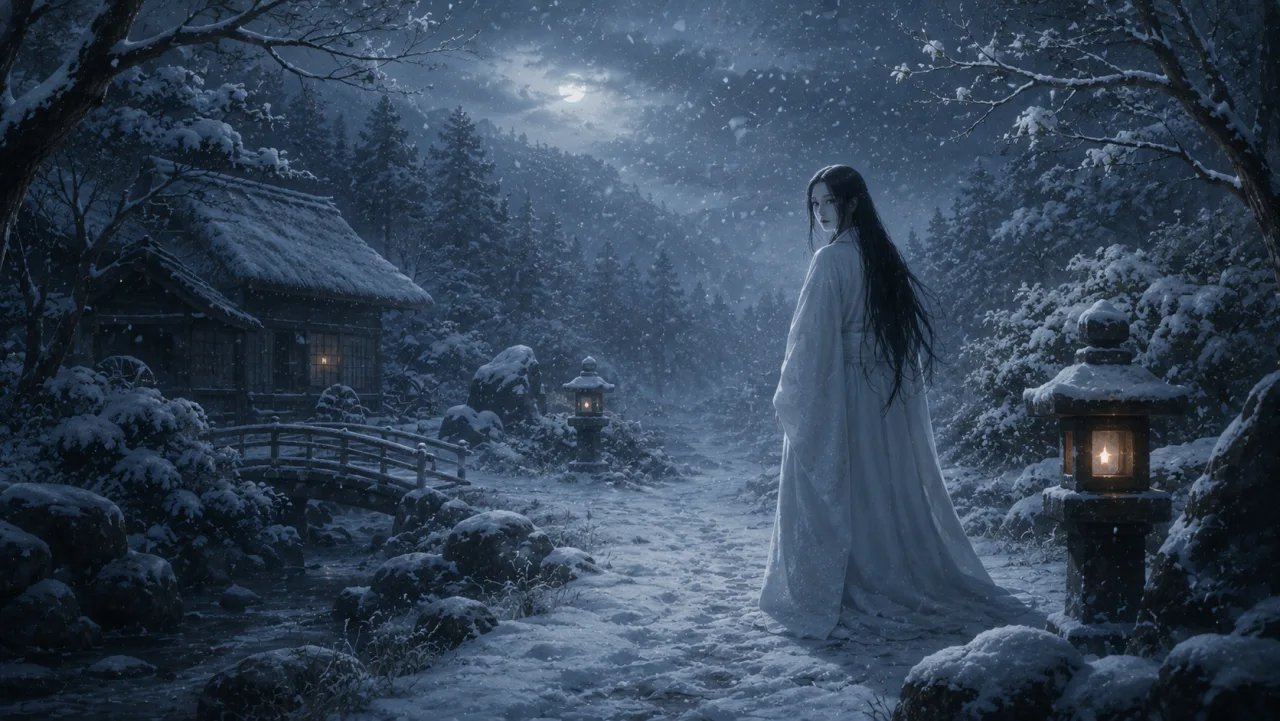
Yuki-Onna
高等学校 英語 第1学年 ReadingLiterature 目安 45 分
学習のめあて
- 物語の三部構成(嵐の夜の遭遇/O-Yukiとの出会い/約束の破綻)を英文で追う
- 自然描写(the awful wind, snow-light, bright white mist など)と心情描写の絡みを読み取る
- 民話の中に古典的に現れる「禁忌(タブー)」のモチーフを、英語で味わう
- 重要語彙(apprentice, ferry-boat, brazier, betrothed, shudder など)を文脈の中で身につける
本文
Background (背景)
「Yuki-Onna(雪女)」は、雪深い夜に現れて旅人を凍らせるという、日本各地の民間伝承に語り継がれる存在です。ハーンは、この話を妻のセツに語ってもらい、武蔵国(現在の埼玉県あたり)を舞台に短編に仕立て上げました。Mujina よりも長く、自然描写と心情描写が美しく絡み合う一編で、結末の場面は怪談文学の白眉と評されます。
物語の核は、ある冬の嵐の夜に交わされた「決して口外しない」という約束です。約束を破ったらどうなるか——それは民話の世界に古くから現れる「禁忌(タブー)」のモチーフですが、この物語ではその結末に、単なる恐怖以上の哀しみが滲んでいます。
Original Text
In a village of Musashi Province, there lived two woodcutters: Mosaku and Minokichi. At the time of which I am speaking, Mosaku was an old man; and Minokichi, his apprentice, was a lad of eighteen years. Every day they went together to a forest situated about five miles from their village. On the way to that forest there is a wide river to cross; and there is a ferry-boat. Several times a bridge was built where the ferry is; but the bridge was each time carried away by a flood. No common bridge can resist the current there when the river rises.
Mosaku and Minokichi were on their way home, one very cold evening, when a great snowstorm overtook them. They reached the ferry; and they found that the boatman had gone away, leaving his boat on the other side of the river. It was no day for swimming; and the woodcutters took shelter in the ferryman’s hut,—thinking themselves lucky to find any shelter at all. There was no brazier in the hut, nor any place in which to make a fire: it was only a two-mat hut, with a single door, but no window. Mosaku and Minokichi fastened the door, and lay down to rest, with their straw rain-coats over them. At first they did not feel very cold; and they thought that the storm would soon be over.
The old man almost immediately fell asleep; but the boy, Minokichi, lay awake a long time, listening to the awful wind, and the continual slashing of the snow against the door. The river was roaring; and the hut swayed and creaked like a junk at sea. It was a terrible storm; and the air was every moment becoming colder; and Minokichi shivered under his rain-coat. But at last, in spite of the cold, he too fell asleep.
He was awakened by a showering of snow in his face. The door of the hut had been forced open; and, by the snow-light (yuki-akari), he saw a woman in the room,—a woman all in white. She was bending above Mosaku, and blowing her breath upon him;—and her breath was like a bright white smoke. Almost in the same moment she turned to Minokichi, and stooped over him. He tried to cry out, but found that he could not utter any sound. The white woman bent down over him, lower and lower, until her face almost touched him; and he saw that she was very beautiful,—though her eyes made him afraid. For a little time she continued to look at him;—then she smiled, and she whispered:—“I intended to treat you like the other man. But I cannot help feeling some pity for you,—because you are so young... You are a pretty boy, Minokichi; and I will not hurt you now. But, if you ever tell anybody—even your own mother—about what you have seen this night, I shall know it; and then I will kill you... Remember what I say!”
With these words, she turned from him, and passed through the doorway. Then he found himself able to move; and he sprang up, and looked out. But the woman was nowhere to be seen; and the snow was driving furiously into the hut. Minokichi closed the door, and secured it by fixing several billets of wood against it. He wondered if the wind had blown it open;—he thought that he might have been only dreaming, and might have mistaken the gleam of the snow-light in the doorway for the figure of a white woman: but he could not be sure. He called to Mosaku, and was frightened because the old man did not answer. He put out his hand in the dark, and touched Mosaku’s face, and found that it was ice! Mosaku was stark and dead...
By dawn the storm was over; and when the ferryman returned to his station, a little after sunrise, he found Minokichi lying senseless beside the frozen body of Mosaku. Minokichi was promptly cared for, and soon came to himself; but he remained a long time ill from the effects of the cold of that terrible night. He had been greatly frightened also by the old man’s death; but he said nothing about the vision of the woman in white. As soon as he got well again, he returned to his calling,—going alone every morning to the forest, and coming back at nightfall with his bundles of wood, which his mother helped him to sell.
One evening, in the winter of the following year, as he was on his way home, he overtook a girl who happened to be traveling by the same road. She was a tall, slim girl, very good-looking; and she answered Minokichi’s greeting in a voice as pleasant to the ear as the voice of a song-bird. Then he walked beside her; and they began to talk. The girl said that her name was O-Yuki; that she had lately lost both of her parents; and that she was going to Yedo, where she happened to have some poor relations, who might help her to find a situation as a servant. Minokichi soon felt charmed by this strange girl; and the more that he looked at her, the handsomer she appeared to be. He asked her whether she was yet betrothed; and she answered, laughingly, that she was free. Then, in her turn, she asked Minokichi whether he was married, or pledged to marry; and he told her that, although he had only a widowed mother to support, the question of an “honorable daughter-in-law” had not yet been considered, as he was very young... After these confidences, they walked on for a long while without speaking; but, as the proverb declares, Ki ga aréba, mé mo kuchi hodo ni mono wo iu: “When the wish is there, the eyes can say as much as the mouth.” By the time they reached the village, they had become very much pleased with each other; and then Minokichi asked O-Yuki to rest awhile at his house. After some shy hesitation, she went there with him; and his mother made her welcome, and prepared a warm meal for her. O-Yuki behaved so nicely that Minokichi’s mother took a sudden fancy to her, and persuaded her to delay her journey to Yedo. And the natural end of the matter was that Yuki never went to Yedo at all. She remained in the house, as an “honorable daughter-in-law.”
O-Yuki proved a very good daughter-in-law. When Minokichi’s mother came to die,—some five years later,—her last words were words of affection and praise for the wife of her son. And O-Yuki bore Minokichi ten children, boys and girls,—handsome children all of them, and very fair of skin.
The country-folk thought O-Yuki a wonderful person, by nature different from themselves. Most of the peasant-women age early; but O-Yuki, even after having become the mother of ten children, looked as young and fresh as on the day when she had first come to the village.
One night, after the children had gone to sleep, O-Yuki was sewing by the light of a paper lamp; and Minokichi, watching her, said:—
“To see you sewing there, with the light on your face, makes me think of a strange thing that happened when I was a lad of eighteen. I then saw somebody as beautiful and white as you are now—indeed, she was very like you.”...
Without lifting her eyes from her work, O-Yuki responded:—
“Tell me about her... Where did you see her?”
Then Minokichi told her about the terrible night in the ferryman’s hut,—and about the White Woman that had stooped above him, smiling and whispering,—and about the silent death of old Mosaku. And he said:—
“Asleep or awake, that was the only time that I saw a being as beautiful as you. Of course, she was not a human being; and I was afraid of her,—very much afraid,—but she was so white!... Indeed, I have never been sure whether it was a dream that I saw, or the Woman of the Snow.”...
O-Yuki flung down her sewing, and arose, and bowed above Minokichi where he sat, and shrieked into his face:—
“It was I—I—I! Yuki it was! And I told you then that I would kill you if you ever said one word about it!... But for those children asleep there, I would kill you this moment! And now you had better take very, very good care of them; for if ever they have reason to complain of you, I will treat you as you deserve!”...
Even as she screamed, her voice became thin, like a crying of wind;—then she melted into a bright white mist that spired to the roof-beams, and shuddered away through the smoke-hole.... Never again was she seen.
日本語訳(参考)
武蔵の国のある村に、二人の樵(きこり)が住んでいた。名を茂作(もさく)と巳之吉(みのきち)といった。私が今語っている時代、茂作は老人で、その弟子の巳之吉は十八の若者だった。二人は毎日、村から五マイルほど離れた森へ一緒に通っていた。森への途中には大きな川があり、渡し舟があった。何度も橋がかけられたが、洪水のたびに流されてしまう。川が増水すると、並の橋ではその流れに耐えられないのだ。
ある凍えるような夕方、二人が帰路についていると、大吹雪が彼らを襲った。渡し場に着いてみると、舟は対岸に置かれたまま渡し守はいない。泳げる日ではなかったので、二人は渡し守の小屋に避難した——とにかく屋根のある場所が見つかっただけでも幸運だと思いつつ。小屋には火鉢もなければ火をおこせる場所もない。二畳ほどの広さで、戸が一つあるだけ、窓もない。茂作と巳之吉は戸を閉ざし、藁の蓑をかぶって横になった。最初はそれほど寒く感じず、嵐もすぐに通り過ぎるだろうと思っていた。
老人はすぐに眠ってしまったが、若い巳之吉は長いこと寝つけなかった。ものすごい風と、戸に叩きつける雪の絶え間ない音を聞きながら。川は轟き、小屋は海に揺れるジャンク船のようにきしむ。恐ろしい嵐だった。空気は刻々と冷たくなり、巳之吉は蓑の下で震えた。しかしついに彼も、寒さに抗えず眠りに落ちた。
顔に雪が降りかかってきて目を覚ました。小屋の戸が押し開けられている。雪明かりの中、一人の女が部屋の中にいるのが見えた——全身白ずくめの女である。彼女は茂作の上にかがみこんで、息を吹きかけていた——息は明るい白い煙のようだった。ほとんど同じ瞬間、女は巳之吉のほうを向き、彼の上に身をかがめた。巳之吉は叫ぼうとしたが、声が出ない。白い女は顔がほとんど触れんばかりまで彼の上にかがみこむ。その美しさは際立っていた——目だけは恐ろしかったが。しばらく彼を見つめてから、女は微笑み、ささやいた——「あなたも、もう一人の男と同じように扱うつもりでした。でも、あなたがあまりに若いので、つい憐れみがわいてしまうのです……。可愛い坊や、巳之吉。今夜はあなたを傷つけません。けれども——今夜見たことを、たとえあなたの母親にも、決して人に話してはなりません。話せば、私はそれを知ります。そして、そのときはあなたを殺します……私の言うことを忘れないで!」
そう言うと、女は彼から離れ、戸口を抜けて消えた。すると巳之吉は動けるようになった。跳び起きて外を見た。しかし女はどこにもいなかった。雪は激しく小屋に吹き込んでくる。巳之吉は戸を閉め、薪を何本も詰めて支えとした。風が戸を開けたのだろうか、自分は夢を見ていただけで、戸口の雪明かりを白い女と見間違えたのだろうか——でも、確信は持てなかった。茂作に呼びかけた。返事がないことに怯えた。暗闇の中で手を伸ばし、茂作の顔に触れた——氷だった! 茂作は硬直し、息絶えていた……。
夜明け頃には嵐は止んでいた。日の出を少し過ぎて戻ってきた渡し守は、凍った茂作の遺体のかたわらに、気を失って横たわる巳之吉を見つけた。巳之吉はすぐ介抱され意識を取り戻したものの、あの恐ろしい寒さの後遺症で長く床についた。老人の死にも深く打ちのめされたが、雪の白い女の幻のことは何一つ口にしなかった。回復した巳之吉は仕事に戻り、朝ひとり森へ通い、夕方には薪を背負って帰ってきた。母親はその売りさばきを手伝った。
翌年の冬のある夕方、家路をたどる巳之吉は、同じ道を旅していた一人の娘を追い越した。背が高くすらりとした、たいそう美しい娘だった。巳之吉の挨拶に、彼女は小鳥のさえずりのように耳に心地よい声で答えた。それから二人は連れ立って歩きはじめ、話を交わした。娘の名は「お雪(オユキ)」。最近両親を亡くし、江戸に縁の少し薄い親戚を頼って、そこで奉公先を見つけるつもりだという。巳之吉はすっかりこの不思議な娘に惹かれた。見れば見るほど美しく感じる。「あなたは婚約していますか」と訊くと、娘は笑って「いいえ、自由の身です」と答えた。今度は娘のほうから巳之吉に「あなたは結婚していますか、それとも約束されていますか」と尋ねる。巳之吉は、母を一人扶養しているだけで、まだ若いから「お嫁さん」のことは話に出ていない、と答えた。打ち明け話を交わしたあと、二人は長いこと黙って歩き続けた。だが、ことわざにもあるように、「気があれば、目も口ほどにものを言う」。村にたどり着く頃には、二人は互いにすっかり気に入り合っていた。巳之吉はお雪に、しばらく家で休んでいくよう勧めた。少し恥じらってためらった末に、お雪はついて行った。巳之吉の母も歓迎し、温かい食事を用意した。お雪のあまりに上品な振る舞いに、巳之吉の母はすぐにこの娘を気に入り、江戸への旅を延ばすよう説得した。そして話の自然の成り行きで、お雪は結局、江戸へは行かないことになった。彼女は「お嫁さん」として、その家にとどまったのである。
お雪は申し分のない嫁となった。五年後に巳之吉の母が亡くなったとき、その最後の言葉は息子の妻への愛と賞賛だった。お雪は巳之吉に十人の子を産んだ。男の子も女の子も、みな美しく、肌の白い子たちだった。
村の人々はお雪を「生まれつき自分たちとは違う、見事な人」と思っていた。村の女たちの多くは早く老けこむ。だがお雪は十人の子の母となっても、はじめてこの村にやってきた日と同じくらい、若く瑞々しいままだった。
ある晩、子供たちが寝静まったあと、お雪は行灯の明かりで縫い物をしていた。巳之吉はその姿を見ていて、こう言った——
「そうやってお前が縫い物をしていると、灯りに照らされた顔が、十八のころに会った不思議な人を思い出させる。あの人もお前と同じくらい美しく、白かった——本当に、お前とよく似ていたよ」……
お雪は手を止めずに、目を上げることなく答えた——
「その人のことを話してください……どこで会ったのですか」
そこで巳之吉は、あの渡し守の小屋の恐ろしい夜のこと——微笑みながらささやいた白い女のこと——茂作老人の物言わぬ死のこと——をすべて話した。そして言った——
「寝ていたのか起きていたのか、あんなに美しい者を見たのは、あの一度きりだった。もちろん、あれは人間ではなかった。私はとても恐ろしかった——本当に、ひどく恐ろしかった。でもあの人はあんなにも白かった!……ほんとうに今もって、あれが夢だったのか、それとも『雪女』だったのか、はっきりしないんだ」
お雪は縫い物を投げ捨て、立ち上がり、座っている巳之吉の上に身をかがめて、その顔に向かって金切り声をあげた——
「あれは私です——私——私! 雪は私だったのです! あのとき、一言でも口にしたら殺すと、はっきり言ったはずです!……あそこに眠っている子供たちのことがなければ、今ここで、私はあなたを殺すでしょう! これからは、子供たちをほんとうに、ほんとうに大事にしなさい。もし子供たちがあなたを恨むようなことがあれば、私はあなたを当然の報いで扱います!」……
叫び声はやがて細く、風のすすり泣きのような響きに変わった——そしてお雪は明るい白い霧となって屋根の梁まで渦巻き昇り、煙抜きから震えるように消えていった……。二度と彼女の姿を見る者はなかった。
語句の意味
各見出し語をクリックすると、外部辞書で詳しい意味を調べられます。 ※ Wiktionary について
- Yuki-Onna(雪女) K 雪の精霊。雪深い夜に現れて旅人を凍らせるとされる、日本各地の伝承上の存在。
- Musashi Province K 武蔵国(むさしのくに)。現在の東京・埼玉・神奈川北東部にあたる旧国名。
- woodcutters K きこり(樵)。
- apprentice K 弟子、見習い。
- ferry-boat / ferryman / ferry K 渡し舟/渡し守/渡し場。橋がない川を舟で渡す手段。
- carried away by a flood K 洪水で流される。
- snowstorm K 吹雪(ふぶき)。
- overtook them K (嵐が)彼らを追いかけて襲った、襲来した。
- took shelter K 避難した、雨宿りした。
- brazier K 火鉢(ひばち)。炭火を入れる暖房具。
- two-mat hut K 二畳の小屋。「畳二枚分」の小さな小屋。
- rain-coats(straw rain-coats) K 蓑(みの)。藁で作った、雨や雪をしのぐ昔の合羽。
- slashing of the snow K 雪が叩きつける(ように降る)。
- roar / roaring K (川が)轟く、ごうごうと鳴る。
- creaked like a junk at sea K 海を行くジャンク船のようにきしんだ。「junk」は中国・東南アジアの伝統的な帆船。
- shivered K 震えた(寒さで)。
- snow-light (yuki-akari) K 雪明かり。雪が積もって白く明るく見える状態。ハーンは日本語をそのまま残している。
- stoop / stooped K かがむ、身をかがめる。
- utter any sound K 声を発する。
- whispered K ささやいた。
- pity K あわれみ、同情。
- billets of wood K 薪(まき)の小割り。「billet」は薪に切った棒状の木材。
- stark and dead K 硬直して死んでいる。「stark」は強い意味の「完全に」。
- senseless K 意識を失った、気絶した。
- Yedo(江戸) K 今の東京の旧称。
- betrothed K 婚約している。
- the proverb declares: Ki ga aréba, mé mo kuchi hodo ni mono wo iu K 「気があれば、目も口ほどにものを言う」。日本のことわざ。原文では訳して "When the wish is there, the eyes can say as much as the mouth." を併記している。
- honorable daughter-in-law K 「お嫁さん」(敬意を込めた呼び方)。原文では引用符でくくられて日本文化の表現として強調されている。
- took a sudden fancy to her K 急に彼女を気に入った。
- country-folk K 田舎の人々、近所の村人。
- fair of skin K 色白の、肌が白い。
- by the light of a paper lamp K 行灯(あんどん)の光で。
- flung down K (縫い物を)放り出した。「fling」の過去形。
- shrieked K 鋭く叫んだ、金切り声をあげた。
- melted into a bright white mist K 明るい白い霧(もや)に溶けていった。
- spired to the roof-beams K (霧が)渦巻きながら屋根の梁(はり)まで立ち昇った。
- shuddered away K 震えるように去って行った。
- smoke-hole K 煙抜き。昔の家屋の屋根に開けられた、囲炉裏の煙を逃がす穴。
考えてみよう
- Where does the story open? Describe the setting (province, season, characters).
- What does the White Woman do to old Mosaku and to Minokichi respectively? Why does she spare Minokichi?
- What promise does the White Woman make Minokichi swear? Read aloud her exact words.
- How does Minokichi meet O-Yuki, and what makes the reader (and his mother) so charmed by her?
- What single sentence finally reveals O-Yuki’s true identity to the reader? Where in the story does it appear?
- Why does O-Yuki not kill Minokichi at the end, even though he has broken his promise?
- 「禁忌(タブー)」を破ったら罰せられる、というモチーフは民話によく出てきます。日本や世界の他の物語で、同じようなパターンを持つお話を一つ挙げ、Yuki-Onna との共通点・相違点を考えてみましょう。
- ハーンは日本語の単語(yuki-akari, Yedo, O-Yuki, 諺)を翻訳せずに残しています。なぜそうしたと思いますか。
指導要領との対応
このページは、文部科学省「高等学校学習指導要領(平成30年告示)」英語 第1学年の 以下の指導事項を意識して編集しています。
- 英語コミュニケーションI — 物語の流れや登場人物の心情を、必要に応じて情報を整理しながら把握する
- 英語コミュニケーションI — 聞いたり読んだりしたことを基に、情報や考えなどを話して伝え合うやり取りを行う
- 論理・表現I — 文章の論理の展開を捉え、自分の考えを述べる
※ 文部科学省告示の本文ではなく、編集者による要旨の言い換えです。 正確な指導事項は文部科学省の公式資料を参照してください。
関連する教材
Mujina
「むじな」— 江戸の紀伊国坂で、泣いている若い女に声をかけた男の話。日本の怪談を英語で書いた小泉八雲(ラフカディオ・ハーン)の代表作『Kwaidan』から、最も短く印象深い一編。
5文型で学ぶ英語の核心 — 文型・必須イディオム・大学受験頻出語彙の総合教材
英語のすべての文は、たった「5つの文型」に整理できる。本教材ではそれぞれの文型の代表動詞・典型例・頻出イディオムを文型ごとに整理し、大学受験までに身につけたい必須語彙約 200 語を、文型のなかで自然に提示する。1教材で受験英語の核心を立体的に把握する設計。
一寸法師 (簡約版・冒頭)
おじいさんとおばあさんが、神さまにおねがいして 一寸法師が うまれた、ふしぎな はじまりのおはなし。
走れメロス(抜粋)
「メロスは激怒した」— 王の暴政に怒り、友を人質に立てて妹の結婚式に駆けつけ、約束の刻限までに王城へ走り帰る青年メロス。太宰治が古代ギリシアの伝承を借りて描く、人を信じる勇気の物語。本ページは抜粋。
学習メモ
ログイン中のユーザーのみ利用できます。記入は自動でクラウドに保存され、別端末からも参照できます。
AI 先生に聞く
教材の内容について、AI に質問できます。実験的な機能です。 AI は時に誤った内容を答えることがあります。最終的には自分で考え、 本文を確認してください。
この教材を改善する
誤字・誤訳・事実誤認の報告、語注や発問への提案など、現場での気づきを直接 GitHub Issue に投稿できます。GitHub アカウントがあれば誰でも参加できます。
出典・ライセンス
- 原文: Lafcadio Hearn(小泉八雲)「Yuki-Onna」(1904年)
- 入力テキスト: Project Gutenberg (底本:Kwaidan: Stories and Studies of Strange Things, Houghton, Mifflin and Company, Boston / New York, 1904 — Project Gutenberg eBook #1210)
- 原文の権利: パブリックドメイン
- 編集・語注・発問・解説: CC BY 4.0 © project_procopios contributors